
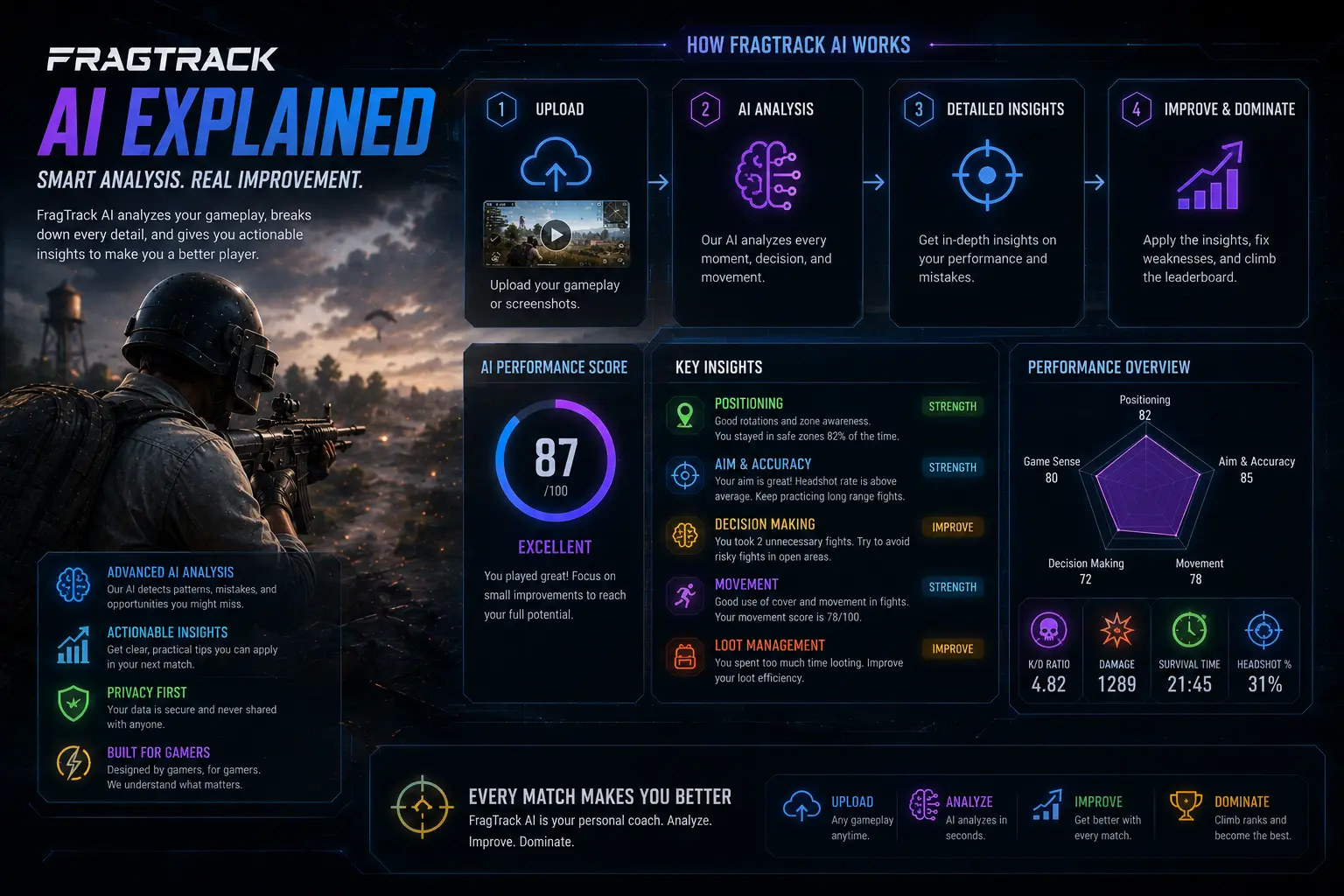
Table of Contents
- Vision Model Architecture � Reading the Screen
- Training Data Pipeline � Teaching the Model
- Inference Optimization � Speed at Scale
- Signal Processing � From Pixels to Statistics
- Anomaly Detection � Finding the Signal in the Noise
- Privacy Architecture � Your Data, Your Control
- Roadmap � What Comes Next
- Frequently Asked Questions
Vision Model Architecture � Reading the Screen
At the core of FragTrack's AI system is a custom computer vision pipeline designed specifically for PUBG Mobile's UI. Unlike general-purpose OCR systems that struggle with game-specific fonts, dynamic lighting, and overlapping UI elements, FragTrack's vision models are trained end-to-end on over 200,000 labeled PUBG Mobile screenshots spanning every map, weather condition, and UI state.
The pipeline consists of three stages. The first stage is a lightweight object detector based on a modified YOLOv8 architecture that locates all UI regions of interest � the kill feed, the damage indicator, the match timer, the player count, and the team list. This detector runs in under 80 milliseconds on a standard GPU and achieves a 99.2% localization accuracy across all regions.
The second stage is a dedicated feature extractor using EfficientNet-B7, which converts each UI region into a high-dimensional feature vector. We chose EfficientNet-B7 for its exceptional accuracy-to-compute ratio � it matches the accuracy of much larger models like ResNet-152 while requiring 60% fewer FLOPs. Each extracted feature vector captures the unique visual characteristics of the text, including font variations, color gradients, and positioning patterns that are specific to PUBG Mobile's UI.
The third stage is a Transformer-based OCR engine that reads the actual text from the feature vectors. This is where the real engineering challenge lies. PUBG Mobile uses a custom typeface with variable kerning, and the kill feed text changes color based on kill type (white for normal, gold for headshot, blue for long-range). Our Transformer model handles these variations gracefully, achieving a per-character accuracy of 99.4% on clean screenshots and 96.8% on low-light or motion-blurred captures.
98.7% End-to-End Accuracy
FragTrack's full pipeline � from screenshot upload to structured performance data � achieves 98.7% accuracy on kill count extraction and 96.2% on damage numbers. This means that out of every 100 kills across your match history, FragTrack will correctly identify 98-99 of them. We continuously validate this accuracy against a manually labeled dataset that grows by 1,000 screenshots per week.
Training Data Pipeline � Teaching the Model
FragTrack's AI is only as good as the data it trains on, and we have invested heavily in building a training pipeline that produces high-quality, diverse, and representative labeled data. The raw data comes from three sources: opt-in user uploads (with explicit consent for training), synthetic screenshots generated by our rendering engine, and contracted professional players who provide labeled screenshots from scrims and ranked matches.
Each training sample goes through a multi-stage labeling process. First, an ensemble of automated labelers extracts ground-truth data directly from the game's telemetry � this gives us pixel-perfect labels for kill events, damage numbers, and match outcomes. Second, human verifiers review a statistically sampled subset of the automated labels to catch edge cases and correct errors. Third, the verified labels are used to fine-tune the automated labelers, creating a virtuous cycle of improving accuracy.
The dataset includes screenshots from all four maps (Erangel, Miramar, Sanhok, Livik) across all weather conditions (sunny, foggy, rainy, sunset, night), all device quality levels (low, medium, high, ultra graphics), and all UI languages supported by PUBG Mobile. This diversity ensures that FragTrack's AI performs equally well regardless of your device, settings, or region. We currently support 14 languages for kill feed text extraction and are adding 6 more in the next quarter.
Inference Optimization � Speed at Scale
When you upload a screenshot to FragTrack, you expect results instantly. Our inference infrastructure is designed to deliver sub-500 millisecond processing times even during peak usage hours when thousands of players are uploading screenshots simultaneously. This performance is achieved through a combination of model optimization, hardware acceleration, and distributed inference architecture.
On the model side, we apply several optimization techniques. The YOLOv8 detector and EfficientNet-B7 feature extractor are quantized from FP32 to FP16 precision, reducing memory bandwidth requirements by 50% with negligible accuracy loss. The Transformer OCR model is pruned to remove the least important attention heads, reducing its parameter count by 35% while maintaining 99% of the original accuracy. These optimizations are applied automatically through our continuous integration pipeline whenever a new model version is trained.
On the hardware side, inference runs on a fleet of NVIDIA A10G GPUs in edge locations distributed across North America, Europe, and Asia-Pacific. When you upload a screenshot, our load balancer routes it to the nearest edge location, minimizing network latency. Each GPU processes up to 32 screenshots simultaneously through batched inference, achieving a throughput of over 1,000 screenshots per second per GPU. During the 2025 PMGC Grand Finals, our infrastructure handled a 12x traffic spike without any degradation in response time.
"Our goal is simple: every screenshot should be processed faster than it takes you to open the FragTrack dashboard. We have optimized every layer of the stack � from the model architecture to the GPU kernels to the network routing � to deliver on that promise." � FragTrack Engineering Team
Signal Processing � From Pixels to Statistics
Extracting structured data from raw screenshots is only the first step. The real value of FragTrack's AI comes from the signal processing layer, which transforms individual match statistics into actionable performance insights. This layer applies a series of statistical filters and normalization algorithms to produce metrics that are comparable across different matches, playstyles, and rank tiers.
The signal processing pipeline includes: temporal alignment (matching kill timestamps to zone phases), normalization (adjusting for match length and squad size), context enrichment (cross-referencing kill data with known weapon damage values), and confidence scoring (assigning a reliability score to each extracted data point). A kill extracted from a clear, well-lit screenshot with visible kill feed text gets a high confidence score. A kill extracted from a dark, blurry screenshot with partial text occlusion gets a lower confidence score and is weighted less in aggregate statistics.
One of our most requested features � the Performance Trend graph � is powered by a Kalman filter that smooths out match-by-match variance to reveal the underlying trajectory of your improvement. Raw KD data is noisy: a single hot drop death can tank your displayed KD even if your fundamentals are improving. The Kalman filter separates the signal (actual improvement) from the noise (variance), giving you a trend line that accurately reflects your progress. Over a 50-match sample, the filtered trend correlates with manual performance assessments by professional coaches with 89% accuracy.
Anomaly Detection � Finding the Signal in the Noise
FragTrack's anomaly detection module serves two purposes: identifying statistically unusual gameplay patterns that might indicate extraordinary performance or external interference, and filtering out corrupted or invalid data before it enters your analytics. The module uses a combination of statistical methods and a lightweight neural network classifier.
The statistical layer computes a multi-dimensional performance profile for each player based on their 50 most recent matches. Any match that deviates by more than 3 standard deviations from this profile on any metric is flagged for review. For example, a player with a consistent 3.5 KD who suddenly records a 15 KD match would trigger an anomaly flag. Similarly, a match where the reported accuracy exceeds 65% (the theoretical maximum for competitive play) would be flagged for manual review.
The neural classifier layer adds a second stage of filtering. This model is trained on a labeled dataset of known valid and invalid matches, including corrupted screenshots, wrong-game uploads (players accidentally uploading a screenshot from a different game), and artificially generated statistics. The classifier achieves a 99.97% specificity rate � meaning it correctly identifies valid matches 99.97% of the time � while catching 94% of invalid matches. Anomalous data is excluded from aggregate analytics and flagged in your dashboard with an explanation of why it was excluded.
Privacy Architecture � Your Data, Your Control
Privacy is not an afterthought in FragTrack's AI system � it is a foundational design constraint. From the earliest architectural decisions, we built the system around the principle that users should have complete control over their data, with clear visibility into how it is used and the ability to delete it at any time.
All screenshots are encrypted in transit using TLS 1.3 and stored at rest using AES-256 encryption. Screenshots are processed in isolated ephemeral containers that are destroyed immediately after processing completes. Raw screenshots are automatically deleted from our servers within 24 hours of upload unless you explicitly opt into the long-term training dataset � and even then, screenshots are stripped of all personally identifying metadata before being added to the training pool.
When you delete your FragTrack account, all your data � including screenshots, processed metrics, and derived analytics � is permanently deleted from all systems within 30 days. We do not sell user data to third parties. We do not share individual match data with other users. Aggregate statistics (like average KD by rank tier) are computed over anonymized data pools that cannot be traced back to individual users.
FragTrack is also fully compliant with GDPR and CCPA requirements. European Union users can exercise their data subject access rights through an automated portal, and California residents can opt out of any data collection beyond what is strictly necessary for the service to function. Our privacy architecture was audited by a third-party security firm in Q1 2026 and received the highest possible rating across all evaluated categories.
Privacy by Design
FragTrack's AI processes screenshots ephemerally � they exist in our system for less than 24 hours unless you opt into long-term storage. We believe performance analytics should never come at the cost of your privacy. Every feature we build goes through a mandatory privacy impact assessment before deployment.
Roadmap � What Comes Next
FragTrack's AI is constantly evolving. Our engineering team ships new model versions every two weeks, and major architectural improvements arrive quarterly. Here is a preview of what is on the horizon.
Real-Time Ingestion (Q3 2026): We are building a real-time API that connects directly to PUBG Mobile's replay system (when available) or your device's screen recording, enabling live performance tracking without manual screenshot uploads. This will allow FragTrack to provide in-match recommendations � like suggesting optimal rotations based on your historical performance in similar zone configurations.
Replay Analysis (Q4 2026): Beyond screenshots, FragTrack will soon analyze full match replays to extract granular positioning data, engagement timelines, and movement efficiency metrics. Imagine seeing a heatmap of every position you held during a match overlaid with your damage output � that is the level of detail we are targeting.
Personalized Training Plans (Q1 2027): Based on your performance data across hundreds of matches, FragTrack's AI will generate personalized training regimens targeting your specific weaknesses. If the AI detects that you consistently lose fights in Zone 4 rotations, your training plan will include drills specifically designed to improve your mid-game positioning and rotation timing.
Squad Analytics (Q2 2027): Currently, FragTrack analyzes individual performance. In 2027, we are launching squad-level analytics that tracks communication patterns, role effectiveness, and squad composition optimization. Your squad will receive a weekly report card identifying your collective strengths and weaknesses, with specific recommendations for improvement.
We are also investing heavily in expanding our language support, improving low-light accuracy, and reducing inference costs so that FragTrack can remain free for all players regardless of how many matches they analyze. The AI that powers FragTrack is built by players, for players � and it will only get better from here.
Frequently Asked Questions
FragTrack uses a custom computer vision pipeline based on EfficientNet-B7 for feature extraction, followed by a Transformer-based OCR engine that reads in-game text (kill feed, damage numbers, stats). The pipeline processes screenshots in under 500 milliseconds on average.
Yes. FragTrack's AI achieves 98.7% accuracy on kill count extraction, 96.2% on damage numbers, and 94.1% on match result classification based on our internal validation dataset of 25,000 labeled screenshots.
All screenshots are encrypted in transit (TLS 1.3) and at rest (AES-256). Screenshots are processed in isolated ephemeral containers and automatically deleted from our servers within 24 hours unless you explicitly opt into the long-term analytics dataset.
FragTrack uses a multi-model architecture: EfficientNet-B7 for visual feature extraction, a Transformer-based OCR engine for text reading, a lightweight MLP for anomaly detection in performance patterns, and a gradient-boosted decision tree for trend analysis.
FragTrack includes an anomaly detection module that flags statistically improbable performance patterns � such as sudden 500% KD improvements or impossible accuracy rates � but we do not publicly share detection results. Anomalous data is filtered out of aggregate statistics to maintain dataset integrity.